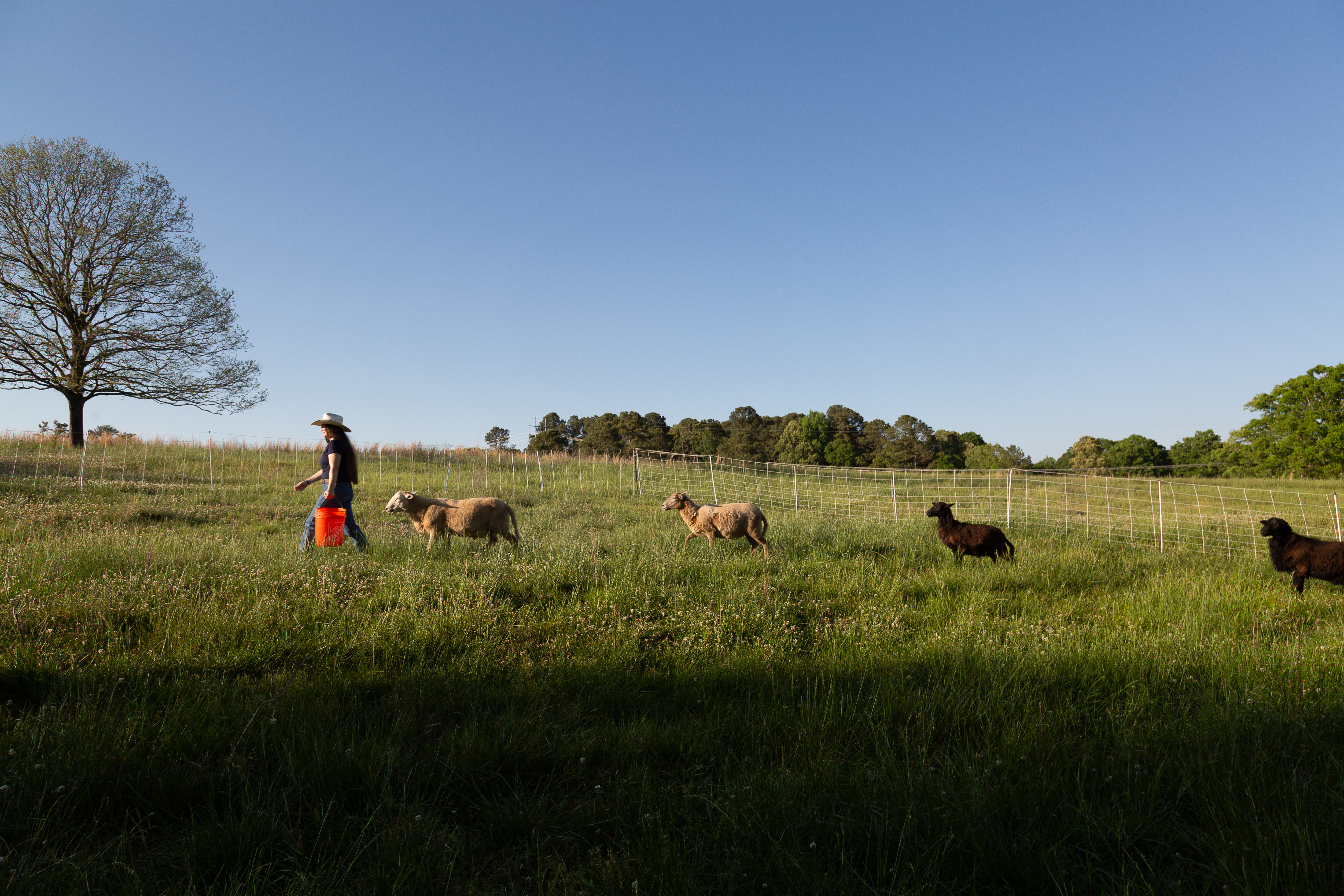


From Pasture to Freezer: The Decisions of Raising Lamb
Before you buy a package of lamb (or chicken or beef) at the grocery store, pick up a bundle at the farmers market, or order directly from a local farm, you have some decisions to make. What matters to you when it comes to food? How much do you want to spend? Does it matter where the animal was raised, how it was cared for, or how it was processed? Are you looking for a particular cut, or simply trying to figure out what to make for Sunday supper?
These are all reasonable questions, and where you choose to spend your money is one way to vote for the things that matter to you. But have you ever stopped to consider all the decisions that a farmer has already made before that package of lamb ever reaches cart and ultimately your freezer?
I certainly hadn’t given it as much thought before I started Deer Creek Pastures. I understood that farming was hard work, that animals needed care, and that growing food required knowledge and experience. What I didn’t fully appreciate was the sheer volume of decisions involved in bringing meat to market, or how many of those decisions would ultimately be mine to make.
I am the person deciding when to breed the sheep, which ram to pair with which ewes, when to rotate the flock to fresh pasture, whether an animal needs veterinary attention, and when it’s time to send lambs to the processor. I’m also the person deciding how much hay to buy, what cuts of meat to offer, what to charge, and how often to remind people that, yes, I do in fact have lamb for sale.
All of this happens while I also work a full-time job, maintain the farm, and attempt to be a reasonably functional human being. It turns out that buying a farm is an excellent way to discover just how many decisions one person can make in a day.
It has also forced me to confront something about myself: I have historically been quite good at analysis paralysis. I love research. I love comparing options, gathering information, and convincing myself that one more article or one more spreadsheet might reveal the perfect answer. Unfortunately, farming has a way of reminding you that the pasture, the sheep, and the weather are not always willing to wait for you to finish your research.
So let’s take a look at the decisions involved in bringing a lamb from the pasture to your plate, and why I’ve been working on becoming a more decisive person along the way.

It Starts Long Before the Lamb Is Born
One of the first decisions in a lamb’s life happens months before it ever enters the world. Breeding sheep requires planning, and the choices I make in one season affect the flock I will have in future years.
When should I breed the ewes? What is the ideal lambing window for my farm? Which ram should go with which group of females? What traits am I trying to improve, and how do I balance those goals with the realities of managing a small flock? These decisions involve genetics, animal health, forage availability, weather, labor, and the practical constraints of running a farm while holding down a day job.
Ideally, I would like the breeding plan to unfold exactly as intended. I would choose the right pairings, keep the groups separated, and have lambs arrive during the window I’ve carefully planned around the rest of my life. The sheep, naturally, have their own ideas.

In fact, I recently had five rams on the farm, with three scheduled to go to the processor on a Monday. The Thursday before, some of the girls were in heat, and my OG ram Tater Tot and his posse apparently decided that the carefully constructed breeding plan was more of a suggestion. The electric netting separating the boys from the girls was no match for their determination and libido, and the boys broke into the ewe group.
There is something humbling about spending time thinking through breeding pairings, planning the timing of the next generation (ideally lambing in March when it warms up a bit), and managing the logistics of getting animals to the processor, only to have your plans derailed by a group of sheep who have neither read your schedule nor expressed any interest in respecting it.
The escape was brief, but the consequences may not be. I won’t know until early February whether the unplanned visit resulted in any accidental pregnancies. Until then, I get to enjoy several months of uncertainty about whether my breeding plans have been thoroughly upended. The sheep have found a way to make me practice sitting with the unknown.
A decision or an incident can have consequences that don’t become apparent for months. You can make a thoughtful plan, invest time and money in executing it, and still have to adjust when reality intervenes. Sometimes, you have to live with the uncertainty, monitor what happens, and wait until you have enough information to make the next decision.
The goal isn’t to create a plan that can never be disrupted. It’s to make good decisions, anticipate what you reasonably can, and be prepared to respond when things don’t go according to plan.
Lambing: When the Decisions Get a Little More Urgent
Once the breeding season is behind me, the next major set of decisions arrives during lambing. This is when months of planning become real animals that need care, and when some decisions come with a much shorter deadline.
When a ewe is getting close to lambing, I have to decide how frequently to check on her, whether to set an alarm for another overnight visit to the barn, and how closely she needs to be monitored. There is a balance between being appropriately attentive and recognizing that I also need sleep, particularly when I have a full workday ahead of me. Sheep are not especially interested in my calendar, and they have yet to demonstrate an appreciation for the concept of business hours.
Then there are the decisions that arise when something goes wrong. Does an animal need assistance? Is this something I can manage with my existing knowledge and experience, or is it time to call a veterinarian? How quickly do I need to act? What are the implications of intervening, and what are the implications of waiting?
Even routine management decisions, such as whether and when to castrate a ram lamb, require consideration of the intended market, breeding plans, animal welfare, and the way I manage my flock. There isn’t a single answer that applies to every farm and every situation.
What makes these decisions different from choosing a new piece of equipment or deciding how to market a product is that an animal is depending on me to get it right. I want to make thoughtful, informed choices, but I also have to recognize when there isn’t time to research every possibility. Sometimes I have to rely on my knowledge, seek appropriate help, and make the best decision I can with the information available.
That responsibility is one of the things I take most seriously about raising livestock. I am not going to get every decision right, but I owe the animals in my care my best judgment, my attention, and a willingness to learn.
Weaning and Grazing: The Math Never Really Stops
As the lambs grow, the decisions change, but they certainly don’t disappear. When should I wean them? How are they growing? Are their mothers maintaining good body condition? What does the pasture look like, and how does the timing of weaning affect the next breeding cycle?
Every option has trade-offs. Keeping lambs with their mothers longer has implications for the ewes and the overall management of the flock. Weaning earlier changes the nutritional and management needs of the lambs. Bottle babies, should I have any, bring an entirely different set of considerations, including the time, supplies, and attention required to keep them thriving.
The same is true of rotational grazing. Moving sheep to fresh pasture sounds straightforward enough until you realize that the decision depends on how much forage is available, how quickly the grass is growing, how much recovery time a field needs, parasite load, and what the animals require. Weather changes, forage growth changes, and the needs of the flock change. A rotation schedule is a useful tool, but it isn’t a substitute for walking the pasture and paying attention to what’s actually happening.
There are also infrastructure decisions woven throughout all of this. What kind of fencing makes sense for the operation? Where should the different groups be housed or grazed? What needs to be repaired or improved, and where will spending more money now save time and trouble later?
Fencing is a particularly good example of the difference between a plan that looks good on paper and one that works in the real world. It has to suit the animals, the terrain, the management system, and the budget. And, as Tater Tot and his posse demonstrated, it also has to account for the possibility that your animals are more motivated than you anticipated.

The larger lesson is that farm management is an ongoing process of observation and adjustment. I am constantly balancing the needs of the animals, the health of the land, the economics of the operation, and the amount of time I can realistically devote to each task. The best decision is rarely the one that optimizes just one of those things. It is the one that makes sense for the farm as a whole.
The Decisions That Don’t Come With Easy Answers
Some farm decisions are satisfying because the results are visible. You repair a fence, move the sheep to fresh pasture, or finish a project that makes the farm work a little better. Other decisions are much harder, particularly when they involve animal health and welfare.
When an animal isn’t thriving, I have to determine what might be wrong, whether veterinary care is needed, how to manage treatment, and whether there are implications for the rest of the flock. I have to consider biosecurity, too. Bringing a new animal onto the farm may improve the genetics of the flock or offer an exciting opportunity, but it also introduces potential health risks that need to be managed through appropriate testing, quarantine, and observation.
And then there is culling, one of the more difficult responsibilities of livestock management. There may come a point when an animal’s recurring health problems, suitability for the flock, or quality of life means that keeping it is no longer the most responsible option. Those decisions require consideration of the individual animal, the welfare of the larger flock, and the realities of what I can reasonably provide.
It is tempting to think that caring deeply about animals should make every decision obvious. In reality, caring deeply can make some decisions more difficult. You want to explore every reasonable option, avoid unnecessary suffering, and do right by the animal. Sometimes, however, there isn’t a perfect outcome available. There are only choices with different risks and consequences, and the responsibility to choose the most compassionate and appropriate path you can.
I don’t think stewardship means getting everything right or having unlimited resources to pursue every possible solution. It means taking the responsibility seriously, recognizing when you need help, and being willing to make difficult decisions rather than avoiding them because they are uncomfortable.
Those are the decisions that have taught me the most about what it means to be a farmer. The work isn’t simply about growing food. It’s about accepting responsibility for living animals and a piece of land, and doing your best to care for both over time.

Processing: From a Living Animal to the Product in Your Freezer
Eventually, for lambs being raised for meat, another set of decisions comes into focus. When is the animal ready for processing? Which processor should I use? When can I get an appointment? What cuts should I request, and how should I balance the preferences of my customers with the practical realities of the animal?
Processing is a significant part of the customer experience, even though it happens outside the farm. The processor, the available appointments, the costs, and the cuts I choose all influence the product I can offer. I have to plan ahead, coordinate logistics, and make sure the finished product aligns with the kind of lamb I want Deer Creek Pastures to sell.
Then there is the financial side. Raising a lamb involves costs for the animal’s care, pasture management, infrastructure, and other farm expenses. Processing adds another cost, and there are additional considerations around storage, packaging, and getting the product to customers. The price of a package of lamb needs to account for more than the value of the animal alone.
I also have to think about what people actually want to cook. How many chops should I offer? How much ground lamb makes sense? Which roasts will appeal to customers, and how can I help people understand how to use cuts they may not be familiar with?
The lamb doesn’t arrive at the processor with a customer survey tucked under its leg, so some of these decisions involve experience, research, and a little educated guesswork. I make the best choices I can, pay attention to what customers buy, and use that information to inform future decisions.
By the time a customer opens a freezer and pulls out a package of lamb, a tremendous amount of work has already happened. Most of it is invisible, and much of it involved decisions the customer will never need to think about. That is perfectly fine. The point isn’t that everyone needs to become an expert in sheep production. It’s that the finished product represents a great deal more than what appears on the label.

Marketing: Apparently, Raising the Lamb Was the Easy Part
Once the lamb is processed and ready to sell, I have another job to do: find the people who want to buy it.
This requires its own set of decisions. How should I price the lamb? Where should I sell it? How do I explain what makes it worth buying? Should I send a newsletter, post on Instagram, offer bundles, or try a different way of reaching local customers?
Pricing is a balancing act between making the farm financially sustainable and offering a product that customers feel good about purchasing. I want people to understand the value of pasture-raised lamb from Northeast Georgia, but I also recognize that everyone has a budget and their own priorities when it comes to food.
Marketing has been a learning experience of its own. I can spend hours making decisions about breeding, pasture management, and processing, then somehow find myself overthinking whether it’s too soon to post about the lamb I am actively trying to sell. How often should I remind people that it’s available? Am I being helpful, or am I being pushy? Is this a good time to send an email, or should I wait until next week?
It turns out that you can raise an animal, arrange its processing, calculate your costs, and develop a product, only to discover that telling people about it is an entirely separate skill.
Of course, nobody can buy something they don’t know is available. Running a small farm business means learning to communicate what you offer, making the buying process straightforward, and finding the balance between sharing your work and overwhelming people with sales pitches. It also means accepting that the first approach you try may not be the best one, and that you can adjust as you learn.
The marketing decisions matter because they connect all the work that happens on the farm to the people who ultimately enjoy the food. A good product doesn’t automatically sell itself, and raising lamb is only one part of building a sustainable farm business.
What Farming Is Teaching Me About Making Decisions
When I look at all these decisions together, I understand why farming has changed the way I think about decision-making. Before I owned a farm, I could afford to spend a long time thinking about a choice, gathering information, and waiting until I felt confident that I had found the best answer. I still love research, and I still believe in making informed decisions. But I have learned that there is a difference between doing your homework and using research as a way to avoid making a decision.
Analysis paralysis can feel productive. You’re reading, comparing, considering alternatives, and trying to anticipate every possible outcome. It feels as though you’re making progress because you’re investing time and effort in the problem. But sometimes, you’re just postponing the moment when you have to choose.
On a farm, that delay can have consequences of its own. A pasture may need to be grazed or rested. An animal may need attention. A fence may need to be repaired before a problem gets worse. A processing appointment may need to be booked before the schedule fills up. The decision doesn’t necessarily become easier because I’ve spent another three hours thinking about it, and the circumstances may not wait for me to feel ready.
I’ve been working on recognizing when I have enough information to make a reasonable decision, even if I don’t have enough information to guarantee the outcome. That means doing the research that matters, considering the meaningful trade-offs, and then making a choice instead of endlessly searching for certainty.
An equally important lesson has been learning not to treat every individual decision as though it will determine the entire future of the farm. When you’re deeply invested in something, it can be easy to convince yourself that you need to get every detail exactly right. The pressure to make the best possible choice can become so great that it makes taking action harder.
But a single decision is rarely the whole story. Some decisions have major consequences and deserve significant consideration. Others can be adjusted, revisited, or improved as I learn more. I am trying to get better at distinguishing between the two, giving important decisions the attention they deserve without spending the same amount of energy on every small choice.
This doesn’t mean being careless or making decisions impulsively. It means recognizing that thoughtful decision-making includes knowing when to stop researching and start acting. It means accepting that I will sometimes make a choice that I would approach differently with the benefit of hindsight. And it means treating those experiences as opportunities to learn rather than evidence that I should never have trusted my judgment in the first place.
Perhaps most importantly, farming has taught me that stewardship is not just about wanting to do the right thing. It’s about taking responsibility for the choices that help make it possible. That includes the decisions that are easy, the ones that are inconvenient, and the ones that don’t have a satisfying answer. It includes knowing when to ask for help, when to spend more money, when to wait, and when waiting is no longer the responsible choice.
I will probably always enjoy a good spreadsheet and the satisfaction of researching a problem thoroughly. I’m not trying to become a person who makes every decision in five minutes and never looks back. I’m trying to become someone who can make the best decision available with the information at hand, accept the uncertainty that comes with it, and move forward.
There will always be more decisions to make. The goal is to get better at making them.
Your Turn to Ask Questions
The next time you buy lamb, you probably won’t be thinking about breeding schedules, pasture recovery, fencing, or the logistics of getting an animal to the processor. You’ll be thinking about what you’re going to cook, whether you have the ingredients you need, and how to get dinner on the table. And that’s exactly as it should be.
But if you’re curious about where your food comes from, what practices were used to raise it, or why a farmer made a particular choice, I think it’s entirely fair to ask. In fact, I would encourage it.
One of the real benefits of buying directly from a farm is the opportunity to have that conversation. You can ask your farmer how they raise their animals, what pasture management looks like on their operation, how they approach animal health, or why they chose a particular practice. You don’t have to know all the right terminology, and you don’t need to worry that asking questions is somehow impolite. It’s entirely reasonable to want to understand how your food was produced. Farmers won’t all make the same decisions, because farms differ in their land, resources, goals, and management systems. Understanding those differences can help you decide which farm and which product aligns with your own priorities.
At Deer Creek Pastures, I don’t expect every customer to know the ins and outs of raising sheep. I am still learning plenty myself. But I am happy to share more about the choices I make and why, because those decisions are part of the story behind the lamb.

And if you’d like to put some Northeast Georgia pasture-raised lamb in your own freezer, you can explore what’s currently available for local pickup.
I’ll be here, making decisions about the next breeding season, the next pasture rotation, and whatever else the sheep have planned for me. Tater Tot and his posse have already demonstrated that the farm does not always follow my carefully laid plans, but I’m learning to take that in stride.
After all, the work of farming is not about making every decision perfectly. It’s about making the best decisions you can, learning from the results, and showing up to make the next one.
Preferably after coffee.
Leave a Reply