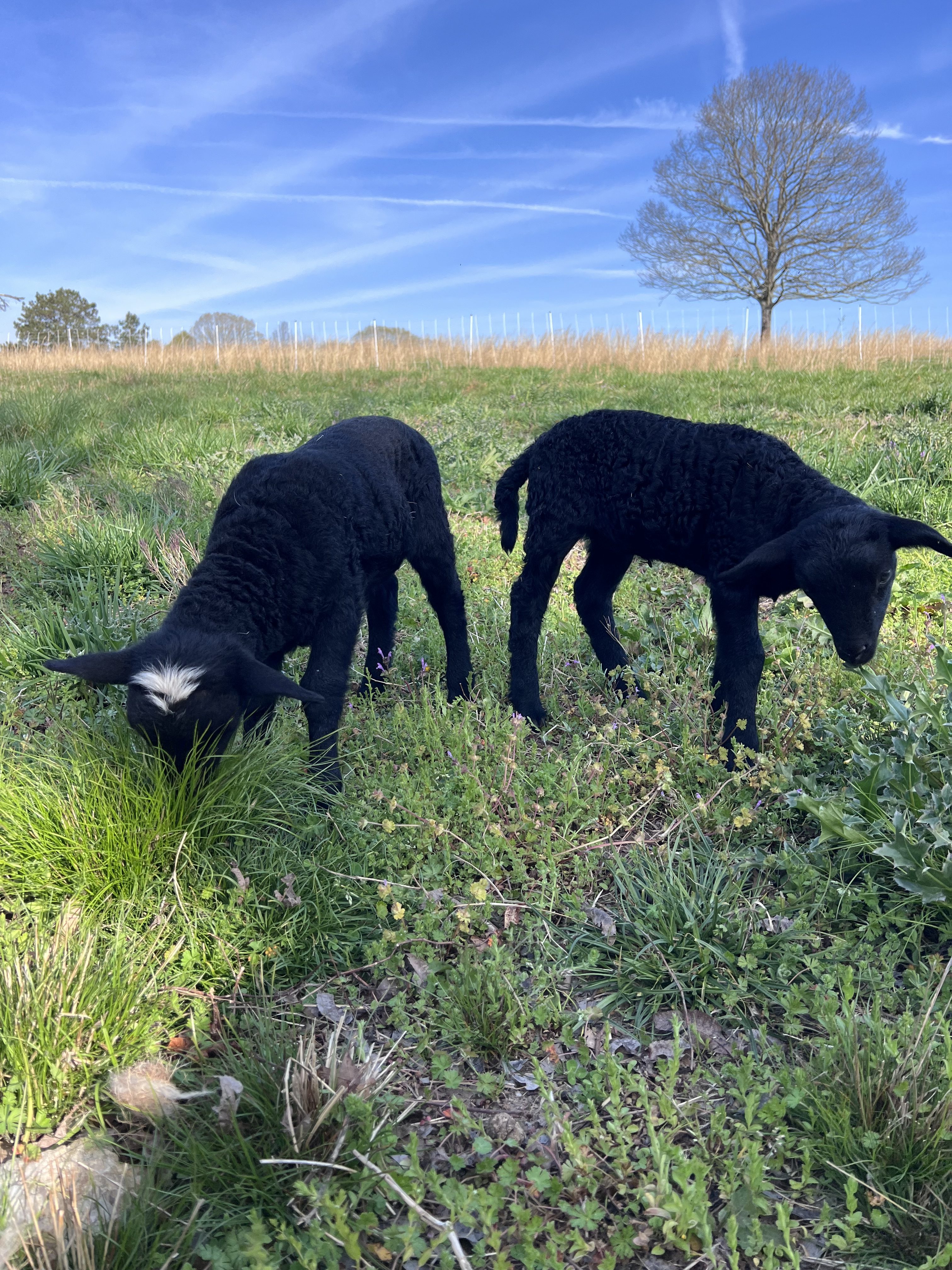


There are moments on a farm that take your breath away—the first time seedlings break through the soil, the smell of fresh-cut hay, the quiet hush of a sunrise over frosted fields, the joy of a piglet laying down for belly rubs. But nothing could have prepared me for the magic of the first lambing season at Deer Creek Pastures.
Preparing for The First Lambing Season
Back in December, I brought home two pregnant ewes—Rosemary and Elderberry—knowing that lambing season would be an entirely new adventure. Rosemary was due first, around February 16, and Elderberry a month later on March 15. I wanted to be as prepared as possible, so I set up a lambing jug in the barn, stocked up on essentials like colostrum replacer, milk replacer, and iodine for umbilical cords, and made sure I had gloves and medicated lube in case I needed to assist. Premier1 became my go-to resource, and I spent countless hours watching YouTube videos and reading about what can go wrong on Reddit’s r/Sheep while keeping my vet on call—because no amount of research can replace expert help when you need it.
Tater Tot: The First Lamb Born at Deer Creek Pastures
On a sunny afternoon just before a winter storm, Rosemary went into labor. I was on a Zoom call when I noticed her acting differently—she lay on her side, kicking at her legs out and moaning loudly. I ran out to check her and saw hooves. It was go-time. Setting a timer, I watched closely, reminding myself of the 30-minute rule for labor progression. An hour later, with no intervention needed, a perfect little ram lamb arrived.
Rosemary immediately started licking him clean—an important sign of bonding—and just like that, Tater Tot became the first lamb born on pasture at Deer Creek Pastures.
The first few days weren’t without challenges. As the temperatures dropped that evening, I noticed he wasn’t nursing well. Rosemary, more interested in her own meal, wasn’t paying him much attention. I attempted to bottle feed him with no luck, and with the help of a kind neighbor, we separated the two and moved them to the barn into the lambing jug for extra monitoring (I set up a camera so that I could check in on them from the house).
By day three, after some vet guidance and extra warmth from barn heaters, Tater Tot figured out nursing. He was simply a big, strong boy struggling with the logistics of feeding. After a few days in the jug, mom and baby moved into a small fenced pen, where Tater Tot got his first lessons in electric fencing (a rite of passage) before rejoining the flock. His sister, Snickerdoodle, was less than thrilled about sharing the spotlight.


Elderberry’s Twins: Jelly Bean & Huckleberry Arrive!
With one lambing under my belt, I turned my focus to Elderberry, who was looking much larger than Rosemary had. On March 16th, she was starting to pant rapidly and her hips were more pronounced, a sign that the babies have lowered into position. I checked on her late that night and at 5 am on March 17th. When I looked out the window at 7:30 am, lambs had arrived.
Unlike Rosemary, Elderberry needed no help or monitoring at all—she delivered her twins quietly in the early hours, proving just how instinctual and resilient sheep can be. The girl twin, Jelly Bean, and the boy twin, Huckleberry (“Huck”), were already cleaned off, walking, and nursing when I found them. It was a textbook-perfect lambing, and exactly the kind of smooth experience I had hoped for.
With three lambs safely on the ground, the first lambing season was officially a success.


Flock Planning: Growing a Sustainable Sheep Program
Starting with two unregistered ewes, my goal has always been to grow a productive and well-managed flock. Since bringing home Rosemary and Elderberry, along with Peanut and Snickerdoodle, I expanded to 6 total ewes some partially and fully registered, with two of them already pregnant. Now that lambing season is complete, I am up to 7 ewes and 2 rams for a flock of 9 sheep. This slow and intentional expansion has allowed me to gain experience while ensuring the health and sustainability of my flock. I was able to experience my first lambing in 2025 without having to manage a ram or a breeding season in 2024.
Introducing Rams Into the Flock
Initially, I planned to castrate Tater Tot and Huckleberry to keep them as companion wethers. However, after observing their early development, I’ve decided to keep them intact. Despite not being fully registered, Tater Tot is showing excellent growth and an ideal body structure for a Katahdin hair sheep, making him a strong potential breeding ram. Additionally, the black lambs are adorable, and I’d love to breed for more of that coloration in the future. Huckleberry has actually already been requested as a stud, once he reaches maturity, for a nearby sheep farm to introduce the potential for black lambs into their flock. Note: black coloring is a recessive trait, so it’s not a guarantee that Huckleberry will sire black lambs.
To further enhance the genetics of my flock, I plan to introduce a fully registered Katahdin ram. Since Peanut is a fully registered ewe, this will allow me to produce purebred Katahdins for sale, giving me a balance of both high-quality breeding stock and diverse genetics for my own flock goals.
Breeding Plans for the Future
By carefully selecting which rams and ewes to breed, I aim to develop a flock that is hardy, parasite-resistant, and well-suited for pasture-based management, all while maintaining the beautiful variety of colors that make my sheep so unique.
All of my ewes, with the exception of Jelly Bean, will be of mature breeding age this summer—ideally at least a year old and weighing around 75+ lbs. Once Tater Tot and Huckleberry are weaned, I will be keeping them separate from the ladies, only joining the ewes for breeding to ensure controlled and efficient breeding cycles.
This approach should allow me to grow the flock responsibly, maintaining good genetics while keeping management as stress-free as possible.
Scrapie Prevention & USDA Flock ID
With the growth of my flock, biosecurity and disease prevention have become a top priority. One of the most important considerations for any sheep farm is Scrapie prevention—a fatal degenerative disease affecting the nervous system of sheep and goats.
To ensure the health of my flock and comply with USDA regulations, I have now obtained a USDA flock ID for tagging and tracking my animals. This will allow me to keep accurate records and participate in Scrapie prevention programs, ensuring that Deer Creek Pastures maintains a healthy, traceable flock for years to come.
Looking Ahead: The Future of Deer Creek Pastures
With my first lambing season behind me, I’m already looking ahead to the future. This experience has reinforced the importance of preparation, patience, and adaptability. Each of the 3 lambs born here to date represents the next chapter in building a sustainable, ethical, and thriving sheep program.
For now, Tater Tot, Jelly Bean, and Huck are enjoying the fresh spring grass, and I’m savoring the joy of this first lambing season.
Here’s to many more seasons of new life and growth at Deer Creek Pastures!
Leave a Reply