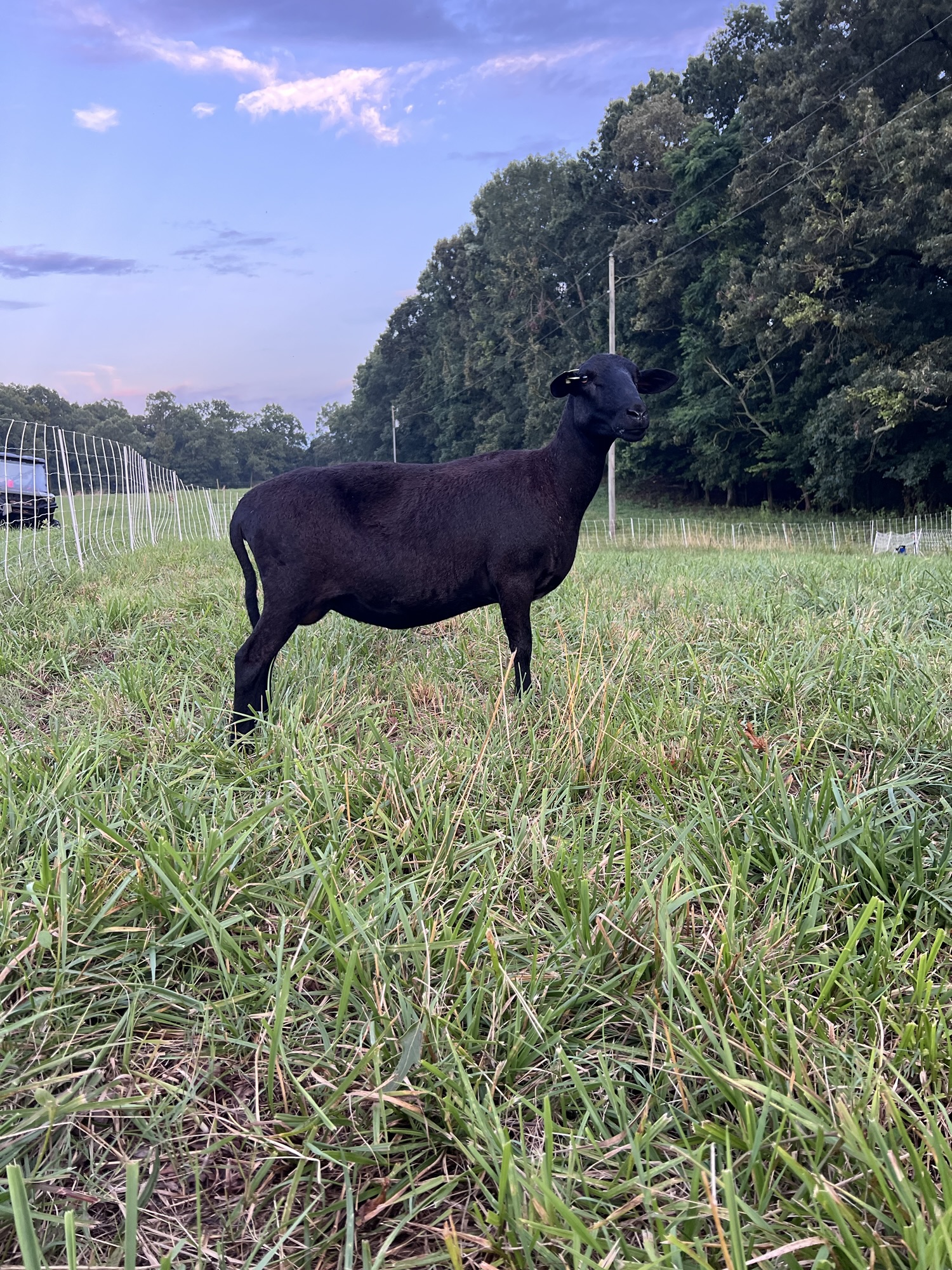


It Started with a Lump
It started quietly, as these things often do. A few weeks back, I noticed a firm lump on Elderberry’s shoulder, a round golf ball sized bump, still covered in her black hair, that could’ve been anything. It has subsequently grown to the size of a tennis ball, and her hair surrounding the abscess has fallen out, making it look as though it could rupture at any moment.
At the same time, I was seeing signs of a parasite burden in the flock, which I chalked up to all the rain and the heatwave we have been experiencing in the Southeast. With a neighboring goat herd losing goats to the barber pole worm, I made a vet appointment to come evaluate the lump and do a fecal egg count for parasite load.
Ahead of the vet visit, I spent hours scouring veterinary forums, small ruminant health guides, and academic articles, and I landed on a possible diagnosis that I had previously never heard of and that I hoped I’d never encounter: caseous lymphadenitis (CL). A chronic bacterial infection that causes recurrent abscesses, spreads easily via contact with pus, and has no known cure. Once it’s in your flock, it lingers, sometimes invisibly, sometimes devastatingly. Worse, it’s highly contagious amongst small ruminants and reportable in the state of Georgia.
Anxiously Awaiting Results
When the vet came out, she collected a sample from the lump for testing and advised that I separate Elderberry and her unweaned twins from the rest of the flock, though she didn’t dig into just how devastating a CL diagnosis could be. It felt like the responsible next step to prepare for the worst, but I was still hoping for a different outcome.
As the days passed and the test results lagged, I dove deeper into any literature I could find on CL. I started to panic as I read about the potential implications to my flock. I texted the vet back to check in on results and ask: Should I go ahead and wean the twins early, just in case? Her reply: “It wouldn’t hurt.”

The Ordeal of Early Weaning
Jelly Bean, ever the gentle ewe lamb, let herself be moved to a new pen without much fuss. Huckleberry (Huck), her twin brother, had other ideas.
In our first attempt, I managed to separate them both from Elderberry. Within 2 days, Huck escaped and bolted straight back to his mother. I did not want to leave Jelly Bean on her own, so I moved her in with the other sheep. Sheep are herd animals and get scared when on their own.
I still wanted to separate Huck from Mom, but he was on to me and extremely skittish any time I got near him. After multiple attempts over the course of a week, and lots of bribery, I caught him again. But when I lifted him to move him from the pen, he wriggled free from my grip and darted off. What followed was 3.5 hours of sheep rodeo. Huck sprinted through the pasture, dodged fences, and ignored every bribe I could offer. He refused to settle into an empty pen that I had set up. Despite pacing outside of the fence that contained the other sheep, he could not be lured to enter that pen and reunite with Jelly bean. He kept attempting to lunge through the electric netting into Elderberry’s pen. Once it hit 10:30 pm and was completely dark out, after running around in the 95 degree heat for hours, I admitted defeat. I let him back into the pen with mom. While I felt extreme guilt over not being able to separate him out to minimize exposure risk, the risks of leaving him out overnight included predator risk as well as electrocution risk if he got stuck in the electric netting trying to break into mom’s pen. So I felt like letting him in with Mom was still the safest move, and by that point, I also assumed he had likely already been exposed.


Results That Came Too Late
Meanwhile, I was left waiting on two sets of lab results: one for Elderberry’s suspected CL, and another for fecal egg counts (FEC) to get a handle on the parasite load.
The fecal test? Took six days, even though samples are supposed to be processed within 48 hours per the Modified McMaster FEC Method. That delay rendered the results meaningless. The results showed extremely low parasite load and no signs of tapeworm despite me actively seeing tapeworm particles in their stool. I had no confidence in the results, so I have subsequently ordered a microscope to be able to conduct my own FEC analyses. I recently took a class through the University of Georgia (UGA) extension on FAMACHA scoring and FECs, so I can now put my studies into action and save costs going forward when I suspect parasites.
The CL results? Those took twelve days. And all I got was a one-line text stating that Elderberry was positive. No follow-up. No answers to my questions, such as my question on whether the rest of the flock needed to be tested, nor the detail that my farm had been reported to my state. No lab report, even though I have now asked for it three times for my records. Just silence.
I later learned that CL lab tests can come back in as little as 48 hours. Twelve days, given the urgency and risk of exposure, is nothing short of unacceptable.
I paid $360 for a vet visit that produced invalid fecal results, unconscionably delayed testing, no lab documentation, and no answers. I’ve been tempted to write a review of my experience to Google, but in a small town with few options, I’m walking a tightrope. Farmers, even those of us operating at a small scale, deserve better than this.
An Ongoing Outbreak, and No One Told Me
Desperate for more context, I reached out to the farm where I bought Elderberry and three other ewes in December (Rosemary, Snickerdoodle, and Peanut). That’s when I learned the full scope: they’d had 23 confirmed CL cases in their flock this spring, with the first abscess appearing in February.
And they never contacted me.
From speaking with the seller and subsequently the State Veterinarian, I now know that CL is a reportable disease in Georgia. However, there’s no requirement that sellers notify previous buyers if cases show up post sale. No contact tracing. No system of accountability. Just guidelines and recommendations to not sell sheep positive for CL at the sale barn or as breeding stock.
I do believe the sellers did not know that their flock had CL when they sold me those sheep. Their first case appeared in February and they have subsequently traced it back to the shearing of their wool sheep. While the seller answered all of my questions when we spoke on the phone, I couldn’t help but wonder why she had not proactively contacted me. She even unironically noted that I am the only other person that she’s met to have dealt with this illness. If they had reached out back in February I could have tested my entire flock before the appearance of an abscess, taken precautions, and maybe prevented some of this biohazard mess.
She also noted that it’s likely the other 3 that I bought from her were exposed. There was no offer of replacement ewes or help with the costs and losses of animals that were bought as breeding stock, but that will likely need to be culled. For context on costs in a scenario like this, there’s the initial cost of the animal that you will no longer get a return on, there’s also all the vet and testing fees, and then euthanization costs for Elderberry and processing fees for any that are positive but in a condition to be harvested for protein.
Elderberry’s Last Days
Elderberry is scheduled to be euthanized on July 2nd. I’ve thankfully found a new vet who comes highly recommended by a friend, though she is located farther away. I’m bracing myself for what will be an extremely sad day. While Elderberry is not my friendliest ewe, she is a great mom, giving birth to the twins smoothly and caring for them attentively the last few months.

What follows is no easier. The question of what to do with her body has been surprisingly difficult to answer. Processing facilities don’t want to deal with the abscess, nor do I want to contaminate someone’s livestock trailer to attempt transport. My county landfill doesn’t accept animal remains. The state vet suggested burning, but lighting a giant sheep bonfire in 100° heat is more than I can stomach right now.
Burial is an option, but not a great one. The bacteria from CL can survive in soil for months (or longer as it’s unknown what happens to the bacteria in anaerobic burial conditions). Every solution feels wrong.
Containment and Contamination
Because CL is so persistent, the area Elderberry has been grazing since the appearance of the abscess is now off-limits for eight months. I’ve had to reconfigure pens, create new grazing areas, and adjust every rotation plan I had for the season.
Every trip to the sheep pens is treated like I’m entering a biohazard zone. I bleach water buckets after every use. I sanitize the soles of my boots before moving to other fields. It’s exhausting.
And it’s not over.
I now need to test the rest of my flock. Any sheep that tests positive will be culled. My new vet, has advised that I should wait 30 days to test, though when that 30 day clock started is an unknown, so I am hoping to get more details during her visit. Hopefully I can test the others in the same visit as the euthanization to minimize costs. When paying for farm visits, in addition to the vet’s time on site, and any tests that are run, you also pay a trip fee, so the costs can add up quickly. If they have no external abscesses, I’ll send them to slaughter so their meat can still feed people, at least one small consolation in this sea of disappointment. I am praying that this hasn’t spread to Stevie and Whitney, my OG sheep. Those ewes have become more like pets over the course of the last year.
A Flock on the Brink
The past few weeks have shaken me to my core. I’ve cried. I’ve felt a lot of anger. I’ve stared at my small flock and wondered if I should throw in the towel on sheep altogether.
I’ve spent more time wrestling lambs early in the morning and late at night, because in tandem with this flock mess, it has been a busy time at work during my day job. I have also been redrawing fencing, setting up new pens, and sanitizing gear more than I ever expected. I’ve shouldered costs, time, lots of exercise chasing around Huck, and anxiety.
And yet, I remain here, determined to figure this out and rebuild my flock once I know the extent of what I am dealing with.
In the search for silver linings, I’m grateful this happened while my flock is still small. I’m grateful that CL rarely spreads to cattle, and that human cases are almost nonexistent. I’m grateful for the clarity I now have about how I’ll handle biosecurity moving forward and my resolve to be honest and ethical toward other farmers. I am also hoping that by sharing my experience, I can raise more awareness around CL, since the resources I found in my own research left me with a lot of questions.
From now on, every sheep that comes to Deer Creek Pastures will require a clean CL test and veterinary health certification before stepping hoof on my land. I will no longer be trusting of reputation or making assumptions based on visual inspection.
What’s Next?
Once I’ve completed flock testing, I’ll share a follow-up post detailing the testing protocol, how I will be managing the remaining flock, what I’ve learned about managing biohazard protocols, and what’s next for rebuilding a clean, healthy herd.
Until then, if you’re reading this and you raise sheep, please read up on CL and monitor the lymph node areas on your sheep. Let’s raise awareness of this nasty and incurable disease. Please advocate for your flock and your community. Because the cost of silence is too high for small producers.
Leave a Reply